

Overview
A prominent digital media platform catering to Millennials and Gen Z was growing rapidly, but its engineering team was not keeping pace. The team excelled at shipping features on request, but struggled to evolve into strategic innovators capable of leading product and technology transformation. To shift from reactive to proactive development, they brought in Hyperjump to support the transformation through a structured, hands-on approach.
The Challenge
- The engineering team functioned more like an internal agency despite having a solid work ethic and collaborative company culture.
- They handled feature requests from business units with minimal structure or tracking.
- There was no task management or ticketing system in place.
- Feature requests often went directly to individual developers.
- There were no clear metrics to measure performance or progress.
- Agile ceremonies and standardized development processes were absent.
- As product demand surged, the business needed more than execution. They needed innovation.
Our Approach
With a dedicated CTO-as-a-Service engagement, Hyperjump introduced a series of foundational improvements designed to help the team scale sustainably.
Agile Overhaul
- Introduced proper Scrum ceremonies, including Sprint Planning, Grooming, Retrospectives, and Daily Standups.
- Defined a clear Definition of Done (DoD) and taught teams to write better user stories, bridging the communication gap between product, design, and development.
- Tracked the team velocity to create predictable, measurable delivery cycles.
CI/CD Transformation
- Established automated CI/CD pipelines, removing manual deployment work from engineers.
- Enforced unit test coverage, improving internal code quality and catching issues early.
- Developers could now focus on innovation, not infrastructure.
Quality Assurance Reinforcement
- Reorganized the QA team into a structured, cross-functional unit.
- Testing became a mandatory release step, supported by better knowledge sharing and coverage planning.
KPI-Driven Growth
- Developed clear internal quality metrics, such as defects caught during QA and unit test coverage, to improve maintainability and reduce technical debt.
- Tracked external quality metrics, including production defects, to ensure faster issue resolution and service reliability.
- Teams gained better visibility into their strengths and growth areas.
Centralized Feedback Handling
- Implemented a proper service desk system to collect bug reports and feedback from business units.
- Ensured every issue was tracked, triaged, and resolved with clear preventive documentation.
Key Learnings
- From Order-Takers to Innovators: Shifting an engineering team from reactive development to proactive innovation requires structural, cultural, and process-level changes, not just additional resources.
- Agile Foundations Enable Predictability: Scrum ceremonies and a clear Definition of Done created shared clarity, accountability, and a consistent delivery rhythm.
- CI/CD Frees Developers to Focus on Value: Automation and test enforcement reduced operational overhead and enabled engineers to focus on innovation.
- Quality Must Be Systematized: Embedding QA into the development cycle improved coverage, reduced defects, and accelerated feedback loops.
- Data-Driven Teams Grow Faster: KPIs helped teams identify performance gaps and make informed decisions for continuous improvement.
- Structured Feedback Loops Build Trust: Centralized issue intake strengthened alignment with business stakeholders and prevented issues from being overlooked.
- Cultural Transformation Is Hands-On: Coaching, real-time collaboration, and continuous support were essential in building ownership and engineering excellence.
Results
After six months of close collaboration and coaching, the results were significant.
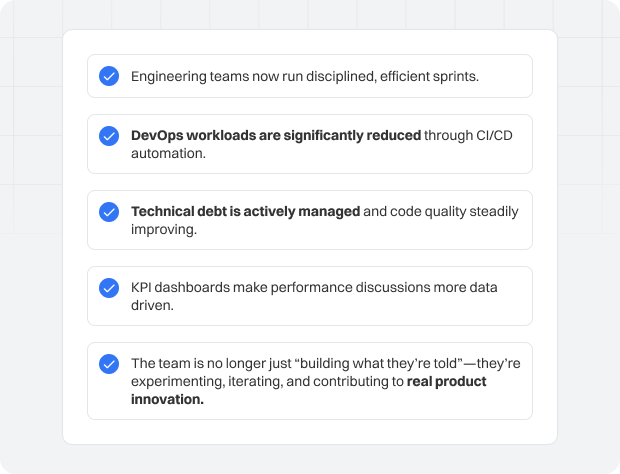
They laid a strong foundation for engineering excellence. With the right processes, metrics, and mindset in place, the team is now prepared to build the future with confidence.